Recently, in a comment, I was accused of not being fair. It made me realize how specialized a sense of unfairness can be. I have no idea who wrote the comment and the identity is not important because I am sure a narrowly focused sense of fairness is something we all possess. I am not talking here about accusations of unfairness that are actually generated by some other disagreement. After all, it’s always nice, at least strategically, to start any criticism by saying the other person is “unfair.” It’s a first cousin of “you are uncollegial.” Both often mean, “I don’t like what you did but do not want to confront the merits.”
One of the most interesting narrow senses of fairness I witnessed was several years ago when faculty had family members in class and, as I recall, family members tended to do very well in those classes. It was a big deal and after months of faculty grumbling and people trying to get other people to raise the issue, there was a meeting and the faculty voted unanimously, or close to it, to ban family members in class. Then the question was what do to about family members already in class. Someone said they should be graded pass/fail. Someone else argued that was unfair because those students registered for those classes more or less expecting to make A’s. That view carried the day. I could not see what was unfair since it seemed like common sense to me that children. should not be in mom or dad’s class..
Mainly, though, fairness seems to be granted first to those we know and people we do not know get short shrift. Like the commentator to my post of mine about a faculty candidate, there was perceived unfairnes to that candidate, but evidently no unfairness to dozens of unknown people waiting patiently for phone calls and excluded by the process and the biases of those running it. Similarly, I could count on two toes (that would be twice) the number of times I have heard someone object to a faculty program, research grant, or tenure because it would be unfair to the taxpayers and tuition payers. In fact, I have heard programs defended not because they are fair to those paying for them, but because not that much money is involved.
Sometimes I do hear the argument that something would be unfair to the students but it’s usually as an added justification for doing what a faculty wants to do. For example, I have not heard, at least publicly, that it is unfair to the students to make up several classes during the last week, not teach needed courses, to schedule courses so they conflict in order to appease faculty or any of the other faculty-favoring practices that make life tougher on students. My hunch is that this would change if discussed at faculty meetings with students in attendance. Unfortunately fair or not fair seems to be a function of the visibility or invisibility of those affected.
I wonder if there is any way to make law school governance decisions behind the veil of ignorance.
Wednesday, November 28, 2007


Monday, November 26, 2007
Answer from Harvard Professor
Those of you who read the immediately preceding post know that I wrote and asked a Harvard Prof about an empirically verifiable statement made with respect to a candidate. The statement was that the candidate had 28 call backs within a few days of the recuiting convention. As it turns out, the reference indicates she confused call backs for campus interviews with interviews at the hiring convention. I attribute no bad faith to anyone involved but the whole incident made me smile. Do you realize the difference between 28 call backs and 28 convention interviews? In the first case, it would mean that nearly every school a candidate met with in DC invited the candidate to campus. I am not sure but this could be a record. The second case is probably about average. That is, I expect having 28 interviews in DC would be about normal. In the word of shopping for cars it would be like losing track of whether you were shopping for a 500 series BMW or Ford Escort. I wonder what kind of environment a person lives in to confuse the two. Again, no doubt at all that it happened just as reported but very very big difference. I do not know but my hunch is that Harvard is one of those schools that hire "off menu" -- S.Ct clerks before and outside of the conference.
Saturday, November 24, 2007
Letter to a Harvard Reference
Dear Professor . . . :
I have not communicated about this until the recruiting effort in connection with [Doe] was completed because I did not want to interfere in the process. What follows is an effort to transcribe a telephone interview with you. The comments are what one expects these days except for the claim of 28 call backs within 3 days. This was evidently news to [Doe] and she corrected the error. The 28 interview claim became a selling point here by both the hiring committee and, evidently, the Dean. There are many explanations for such a statement. Most likely someone here misunderstood your comment in his or her effort to embellish the record. Or, perhaps, call backs got confused with interviews at the hiring convention. Another possibility is that you did not have the facts correct but shot from the hip nonetheless.
It is extraordinarily difficult for productive and deserving students with non elite degrees to find jobs in legal education. The bias is overwhelming and unjustified by any measure of teaching or scholarship success. In fact, schools at the rank of my schools have an abundance of elitist underachievers whose references were as enthusiastic as you were only without the possible misstatement. (Again my assumption is that the error was at our end.)
If the error was at your end, it is my sincere wish that in the future you will give some thought to the candidates who do not have an elitist connetion but are just as talented as students who do. There will be no equal opportunity for those students but it need not be made even less equal by the use of incorrect appeals to market demand as an indicator of potential and quality.
The note provided to our faculty is as follows: ". . . . (Harvard Law School): "I spoke with Professor . . . . at Harvard about [Doe].
Professor . . . was very effusive in her praise of [Doe].. She described her as “terrific,” “really
strong,” “smart and interesting.” She believed we were right to rank her highly as a candidate
and noted that [Doe] had been offered 28 callbacks within three days of the hiring conference
[actually the number is more like 10](this was inserted by the Committee after the interview although the actual number remains unclear). She really became aware of [Doe]’s potential as a scholar
when she supervised her third-year paper. . . . Professor . . .
stated that the paper was extraordinary. [Doe] did lots of leg work to find the cases she reviewed
as well as the factual setting for the cases, and “then she wrote this enormous paper.” . . .
was so impressed she asked [Doe] to present the paper to her . . . course,
something she never does. She gave [Doe] an A+ on the paper, only the second time she has given
such a high grade in 15 years of teaching. Professor . . . said that there are many intelligent
and highly motivated students at Harvard, but even by Harvard standards [Doe] “went above and
beyond what students usually do.” Professor . . . believes [Doe] will be a solid teacher and scholar."
I have not communicated about this until the recruiting effort in connection with [Doe] was completed because I did not want to interfere in the process. What follows is an effort to transcribe a telephone interview with you. The comments are what one expects these days except for the claim of 28 call backs within 3 days. This was evidently news to [Doe] and she corrected the error. The 28 interview claim became a selling point here by both the hiring committee and, evidently, the Dean. There are many explanations for such a statement. Most likely someone here misunderstood your comment in his or her effort to embellish the record. Or, perhaps, call backs got confused with interviews at the hiring convention. Another possibility is that you did not have the facts correct but shot from the hip nonetheless.
It is extraordinarily difficult for productive and deserving students with non elite degrees to find jobs in legal education. The bias is overwhelming and unjustified by any measure of teaching or scholarship success. In fact, schools at the rank of my schools have an abundance of elitist underachievers whose references were as enthusiastic as you were only without the possible misstatement. (Again my assumption is that the error was at our end.)
If the error was at your end, it is my sincere wish that in the future you will give some thought to the candidates who do not have an elitist connetion but are just as talented as students who do. There will be no equal opportunity for those students but it need not be made even less equal by the use of incorrect appeals to market demand as an indicator of potential and quality.
The note provided to our faculty is as follows: ". . . . (Harvard Law School): "I spoke with Professor . . . . at Harvard about [Doe].
Professor . . . was very effusive in her praise of [Doe].. She described her as “terrific,” “really
strong,” “smart and interesting.” She believed we were right to rank her highly as a candidate
and noted that [Doe] had been offered 28 callbacks within three days of the hiring conference
[actually the number is more like 10](this was inserted by the Committee after the interview although the actual number remains unclear). She really became aware of [Doe]’s potential as a scholar
when she supervised her third-year paper. . . . Professor . . .
stated that the paper was extraordinary. [Doe] did lots of leg work to find the cases she reviewed
as well as the factual setting for the cases, and “then she wrote this enormous paper.” . . .
was so impressed she asked [Doe] to present the paper to her . . . course,
something she never does. She gave [Doe] an A+ on the paper, only the second time she has given
such a high grade in 15 years of teaching. Professor . . . said that there are many intelligent
and highly motivated students at Harvard, but even by Harvard standards [Doe] “went above and
beyond what students usually do.” Professor . . . believes [Doe] will be a solid teacher and scholar."
Friday, November 23, 2007
Moms, Dads, and Deans in the World of Elites

Thursday, November 15, 2007
Hiring Bias and Public Legal Education

Elites tend to view themselves as ends rather than means to an end. This is especially the case when it comes to law teaching. Unless public legal education is viewed as a huge and ill-conceived method of redistributing income from lower and middle income groups to relatively higher income groups, its only purpose can be to enhance public welfare. In this sense, both faculty and students are means to an end. Both are necessary components and their efforts should complement each other.
Within the faculty student relationship, though, there is a huge imbalance. Students are relegated to a distant second place. The bias in favor of faculty desires undercuts this complementary relationship and also reduces the return to the public investment. For example:
1. The courses offered are what faculty want to teach, not necessarily what is needed to best prepare students.
2. Teaching times are dictated by faculty. Generally they want to teach from 10-3 on Tues. – Fri. Thus, classes conflict while there are stretches of time when classrooms are empty.
3. Scheduling is dictated by faculty. For example, a 4 credit course may be offered in two two hour sessions. Especially for first year students taking standard courses (as opposed to a skills course) this is pedagogically indefensible and only exists because of a desire to minimize student contact days.
4. Faculty cancel classes for any number of optional activities, often for weeks, and then make up classes (if they are made up) at the end of the semester when students are otherwise swamped.
5. Faculty are often craven about teaching evaluations. Part of effective teaching may be to challenge students yet the prevailing trend is to make them feel good even if this is inconsistent with classroom rigor.
6. Faculty support of grading curves is often motivated by a desire to avoid hard decisions or to avoid “hurting the feelings” of students. The result is that students do not a have a realistic assessment of their progress. For example, at my School, students with a GPA that is even a fraction below a B are very likely to fail the Bar exam.
Within the faculty student relationship, though, there is a huge imbalance. Students are relegated to a distant second place. The bias in favor of faculty desires undercuts this complementary relationship and also reduces the return to the public investment. For example:
1. The courses offered are what faculty want to teach, not necessarily what is needed to best prepare students.
2. Teaching times are dictated by faculty. Generally they want to teach from 10-3 on Tues. – Fri. Thus, classes conflict while there are stretches of time when classrooms are empty.
3. Scheduling is dictated by faculty. For example, a 4 credit course may be offered in two two hour sessions. Especially for first year students taking standard courses (as opposed to a skills course) this is pedagogically indefensible and only exists because of a desire to minimize student contact days.
4. Faculty cancel classes for any number of optional activities, often for weeks, and then make up classes (if they are made up) at the end of the semester when students are otherwise swamped.
5. Faculty are often craven about teaching evaluations. Part of effective teaching may be to challenge students yet the prevailing trend is to make them feel good even if this is inconsistent with classroom rigor.
6. Faculty support of grading curves is often motivated by a desire to avoid hard decisions or to avoid “hurting the feelings” of students. The result is that students do not a have a realistic assessment of their progress. For example, at my School, students with a GPA that is even a fraction below a B are very likely to fail the Bar exam.
7. The use of machine graded, multiple choice exams with recycled questions can hardly be reconciled with an education designed to stress analysis and critical thinking. Law School is, after all, a graduate level education. Those exams, however, can be reconciled with a desire to avoid grading.
These policies are consistent with a sense of entitlement most frequently possessed by those in control of legal education. In a context of low accountability and ineffective management (primarily because management serves at the pleasure of those managed) everything hinges on the character and sense of duty of faculty. Here is the good news: It could be even worse and will be unless hiring policies change.
These policies are consistent with a sense of entitlement most frequently possessed by those in control of legal education. In a context of low accountability and ineffective management (primarily because management serves at the pleasure of those managed) everything hinges on the character and sense of duty of faculty. Here is the good news: It could be even worse and will be unless hiring policies change.
Sunday, November 11, 2007
Not as Much as You Think
 In my previous post I asked the question “Do Elites Think.” I asked facetiously knowing that they do think, at least some. The point I was making is that they are enamored of institutional authority -- Harvard is automatically better than Florida and the recommendation of a Harvard professor more reliable than a Florida professor.
If you have followed this latest series of posts, you know that the UF hiring committee elected to invite exclusively graduates from elite schools plus a couple of people from expensive schools. This is a policy that makes no sense for any school and especially for schools at Florida’s level. One has only to look at the past and current members of the UF faculty who would have been passed over if the policy were in effect at the time of their hiring...
The first interviewee was a Princeton/Harvard product who was touted as having over 20 interviews. In fact, according to the candidate’s Harvard reference, she had 28 callbacks within three days of the hiring conventions. (For those not familiar with the law school system, there is a 3 day meeting of candidates and law school hiring committees. The committees interview about 30 people and some are invited back to campus.)
For those who rely on others and are drawn to bandwagons, this must mean the candidate could not miss. If others want her, surely we want her too. Evidently the Dean and Committee members stressed the number of callbacks as an indicator of how great the candidate must be. Other hiring committees might have read the scholarship, talked to the candidate longer than a 30 minutes, and discussed her with contacts other than the ones identified by the candidate. Some or all of this was done but all in the giant shadow of Princeton/Harvard and 28 callbacks in 3 days. No one dare disagree with Harvard credentials, Harvard references, and 28 other schools. (Did I mention that Harvard profs evidently don’t need to worry about the truth. After all, they create “truth.)
To make a long story short, the actually number of call backs appears to be “closer to 10.” Although the information comes from the candidate herself, I am not sure why it is not an exact number. Could 10 really be 8? And, will it be announced in a few days that it was 5 or even 0. Who knows? More importantly what happens now? Does exactly the same candidate become less desirable?
Thursday, November 08, 2007
Do Elites Think?
Jake: Hi, do you want to talk about that issue some more?
Friday, November 02, 2007
The Fall Election: News for Law Students and Alums

Each fall an election is held. It’s an unusual election in that it involves actual votes and then marketplace “votes.” In both cases, the voters are law professors and the election is held to determine which people will become law professors.
In the vast majority of instances the voters vote against their own students. Instead, their votes are cast for students and alums of a small handful of exclusive and expensive schools. That’s right, collectively they decide that their own students or students trained by their counterparts at similarly ranked law schools are not qualified to be law professors.
So, what is the rationale for slapping the “unqualified” label on these people? One possibility is that these students are poorly trained. Is it really possible that law professors are humble enough to concede that they cannot cut it and are unable to teach effectively enough to prepare people to teach? I’m going to take a wild guess that that is not the explanation.
OK, so maybe the students are just too dumb, ignorant, or lazy that even incredibly good teaching cannot overcome their shortcomings. If it’s not the teaching, it must be the students. Right? So, law professors must be so turned off by their own students that they conclude they are all right to handle the affairs of others – you know, unimportant things like death penalty cases, planning huge estates, arguing the merits child custody battles – but not possibly up to teaching. Think of this message: You are beyond help. Whatever I do “for you” you cannot be as qualified as I am (unless you go through the LLM “cleansing for dollars” process). They must be teaching difference students than I see every year. In fact, right now I have 180 contracts students and I am convinced that some of them in five years could be doing a better job than I am.
So, if it is not the professors and not the students, what is it? And, how did elitist professors come to know whatever they rely on when casting their votes without actually talking to a single applicant in Washington. Arrogant may be the right word here if that means not realizing that you don’t know what you are doing but doing it anyway.
Another thing that puzzles me is why the 90% of students and former students who are not buying or did not buy a brand name legal education are so accepting of being sent the message that they cannot cut it. Is it some kind of Stockholm syndrome whereby students admire those who dismiss them? A power thing? Do they believe the press of their professors? Do they believe what their professors are telling them about themselves? If so that is unfortunate because it is flatly wrong. Hopefully the professors are truthful with the students about other matters.
In the vast majority of instances the voters vote against their own students. Instead, their votes are cast for students and alums of a small handful of exclusive and expensive schools. That’s right, collectively they decide that their own students or students trained by their counterparts at similarly ranked law schools are not qualified to be law professors.
So, what is the rationale for slapping the “unqualified” label on these people? One possibility is that these students are poorly trained. Is it really possible that law professors are humble enough to concede that they cannot cut it and are unable to teach effectively enough to prepare people to teach? I’m going to take a wild guess that that is not the explanation.
OK, so maybe the students are just too dumb, ignorant, or lazy that even incredibly good teaching cannot overcome their shortcomings. If it’s not the teaching, it must be the students. Right? So, law professors must be so turned off by their own students that they conclude they are all right to handle the affairs of others – you know, unimportant things like death penalty cases, planning huge estates, arguing the merits child custody battles – but not possibly up to teaching. Think of this message: You are beyond help. Whatever I do “for you” you cannot be as qualified as I am (unless you go through the LLM “cleansing for dollars” process). They must be teaching difference students than I see every year. In fact, right now I have 180 contracts students and I am convinced that some of them in five years could be doing a better job than I am.
So, if it is not the professors and not the students, what is it? And, how did elitist professors come to know whatever they rely on when casting their votes without actually talking to a single applicant in Washington. Arrogant may be the right word here if that means not realizing that you don’t know what you are doing but doing it anyway.
Another thing that puzzles me is why the 90% of students and former students who are not buying or did not buy a brand name legal education are so accepting of being sent the message that they cannot cut it. Is it some kind of Stockholm syndrome whereby students admire those who dismiss them? A power thing? Do they believe the press of their professors? Do they believe what their professors are telling them about themselves? If so that is unfortunate because it is flatly wrong. Hopefully the professors are truthful with the students about other matters.
Thursday, November 01, 2007
'Nuf Said
Based on data provided to the faculty and my far from always accurate calculations, The University of Florida hiring committee interviewed 31 people in Washington. Here are their law schools:
Harvard – 8
Yale -7
Columbia – 4
NYU - 2
Stanford -2
Chicago -2
Vand. - 1
Penn. – 1
Mich.-1
Virginia -1
UCLA -1
Case Western – 1 (this candidate also has a tax LLM from NYU)
Nine of the schools listed, accounting for 28 of the candidates, are what would be regarded as elite schools. Yes, UF missed by only three people of having an elitist only interview line up. Only 3 candidates came from public schools and two of those are regarded as elite law schools.
The nine schools responsible for 28 candidates were included in a study I made of scholarly productivity of faculty found at 4 Law Schools that are at the bottom of top tier of law schools. I compared the productivity of graduates from those elite schools who end up at the bottom of the top tier with productivity of faculty from all other schools. My results indicate that there was no correlation between level of School and scholarship. There was, however, anecdotal evidence that level of school was correlated with high levels of self promotion and resume building for the same of resume building.
I suspect that the list looks a great deal like that at other schools and that it is roughly like the lists for all schools for many years.
At this point in one of my posts I might attempt to explain why legal education needs another elitist education professor like it needs a lobotomy which is, by the way, what this type of hiring has done for many law schools. But, when you think about it, the burden should be the other way around. In the absence of any evidence of people from these schools make better law professors, why persist. We know why: they look, talk like and have experiences like the people hiring them. But I am asking why they would be the exclusive focus of hiring efforts if one had the best interests of the students and stakeholders in mind.
Harvard – 8
Yale -7
Columbia – 4
NYU - 2
Stanford -2
Chicago -2
Vand. - 1
Penn. – 1
Mich.-1
Virginia -1
UCLA -1
Case Western – 1 (this candidate also has a tax LLM from NYU)
Nine of the schools listed, accounting for 28 of the candidates, are what would be regarded as elite schools. Yes, UF missed by only three people of having an elitist only interview line up. Only 3 candidates came from public schools and two of those are regarded as elite law schools.
The nine schools responsible for 28 candidates were included in a study I made of scholarly productivity of faculty found at 4 Law Schools that are at the bottom of top tier of law schools. I compared the productivity of graduates from those elite schools who end up at the bottom of the top tier with productivity of faculty from all other schools. My results indicate that there was no correlation between level of School and scholarship. There was, however, anecdotal evidence that level of school was correlated with high levels of self promotion and resume building for the same of resume building.
I suspect that the list looks a great deal like that at other schools and that it is roughly like the lists for all schools for many years.
At this point in one of my posts I might attempt to explain why legal education needs another elitist education professor like it needs a lobotomy which is, by the way, what this type of hiring has done for many law schools. But, when you think about it, the burden should be the other way around. In the absence of any evidence of people from these schools make better law professors, why persist. We know why: they look, talk like and have experiences like the people hiring them. But I am asking why they would be the exclusive focus of hiring efforts if one had the best interests of the students and stakeholders in mind.
Tuesday, October 30, 2007
And the Campus Visits Go To . . .
First out of the box for a campus visit is -- do you want to guess? -- You got it. Princeton/Harvard. I don't want to be too quick to be negative. After all maybe this is a person with a story to tell. Overcoming barriers, a zillion dollars of student loans. You never know.
But there is a another variable. Every law school candidate who goes through the normal recruiting channels fills out a form. On the form you are asked to list major publications. I think that excludes things that are not published and especially things that have not been written. Is it too much to attribute to someone who takes this opportunity to list those kinds of things a willingness to bend the rules in the favor of self-interest? And, if that is true, what will this person be like as a colleague? Is this the next person to insist that everything he or she has done -- from an 80 page article to a doodle while having latte at Starbuck's -- is scholarship?
So much for the lessons of history.
But there is a another variable. Every law school candidate who goes through the normal recruiting channels fills out a form. On the form you are asked to list major publications. I think that excludes things that are not published and especially things that have not been written. Is it too much to attribute to someone who takes this opportunity to list those kinds of things a willingness to bend the rules in the favor of self-interest? And, if that is true, what will this person be like as a colleague? Is this the next person to insist that everything he or she has done -- from an 80 page article to a doodle while having latte at Starbuck's -- is scholarship?
So much for the lessons of history.
Dancing the Minuet
Then I thought it is actually all about class bias because to the extent a school is not like the ideal school it means there is a hubris often found among those with a sense of entitement.
1. Hiring is designed, in part, to create an intellectual and philosophical balance so faculty can debate and hone their ideas about important issues. (At many schools, intellectual diversity is threatening.)
2. In hiring, performance, diversity, and energy are valued over credentials.(Most schools place high value on credentials even though they are as reliable as cubic zirconium as an indicator of value.)
3. Discussion can be had about everything – class, race, sexuality, the Middle East – without the discussion becoming personal, or people pouting, or stomping out of the room. (At most schools these matters are taboo because of faint hearts, fears of being labeled, and wanting to avoid complex issues.)
4. There is real collegiality as opposed to facial collegiality. (At many schools the appearance of being “nice” is sufficient and can be used to mask a great deal of self-dealing, free riding, externality production, and closed-door mischief.)
5. The administration and faculty announce and internalize goals and stress accountability. (At some schools, the administration takes whatever happens and spins it in order to claim success.)
6. There is an on-going effort to match the efforts – courses offered, degrees offered, foreign and domestic programs -- of the school with the needs and expectations stakeholders. (At other schools, there is no on-going assessment if someone’s turf would be disturbed.)
7. The faculty abide by the real NYT rule: Don’t do anything you would not want reported on in the NYT. (Many faculty, including some on my faculty, go by the “other” NYT rule: Don’t put anything in writing that you would not want reported in the Times.)
8. The ideal curriculum is planned and professors make sure it is offered even if it means extra effort. (At some schools, teachers are asked what they are “willing” to teach and when and that is what is offered.)
9. The dean has principals and principles. He or she considers the best interests of students and shareholders and does not comprise with self-interested faculty to achieve those ends. (At some law schools, deaning means displeasing the fewest number of faculty.) (Remember the old saying “It’s not a revolution if you ask permission.” How about, “It’s not deaning if you ask permission.”)
10. There is a sense movement, excitement, intellectual ferment, and even some dancing Monday – Friday throughout faculty offices. (Some schools have gone to a Tues – Thurs schedule, faculty are elsewhere, or suffer from the institutional Valium effect.)
1. Hiring is designed, in part, to create an intellectual and philosophical balance so faculty can debate and hone their ideas about important issues. (At many schools, intellectual diversity is threatening.)
2. In hiring, performance, diversity, and energy are valued over credentials.(Most schools place high value on credentials even though they are as reliable as cubic zirconium as an indicator of value.)
3. Discussion can be had about everything – class, race, sexuality, the Middle East – without the discussion becoming personal, or people pouting, or stomping out of the room. (At most schools these matters are taboo because of faint hearts, fears of being labeled, and wanting to avoid complex issues.)
4. There is real collegiality as opposed to facial collegiality. (At many schools the appearance of being “nice” is sufficient and can be used to mask a great deal of self-dealing, free riding, externality production, and closed-door mischief.)
5. The administration and faculty announce and internalize goals and stress accountability. (At some schools, the administration takes whatever happens and spins it in order to claim success.)
6. There is an on-going effort to match the efforts – courses offered, degrees offered, foreign and domestic programs -- of the school with the needs and expectations stakeholders. (At other schools, there is no on-going assessment if someone’s turf would be disturbed.)
7. The faculty abide by the real NYT rule: Don’t do anything you would not want reported on in the NYT. (Many faculty, including some on my faculty, go by the “other” NYT rule: Don’t put anything in writing that you would not want reported in the Times.)
8. The ideal curriculum is planned and professors make sure it is offered even if it means extra effort. (At some schools, teachers are asked what they are “willing” to teach and when and that is what is offered.)
9. The dean has principals and principles. He or she considers the best interests of students and shareholders and does not comprise with self-interested faculty to achieve those ends. (At some law schools, deaning means displeasing the fewest number of faculty.) (Remember the old saying “It’s not a revolution if you ask permission.” How about, “It’s not deaning if you ask permission.”)
10. There is a sense movement, excitement, intellectual ferment, and even some dancing Monday – Friday throughout faculty offices. (Some schools have gone to a Tues – Thurs schedule, faculty are elsewhere, or suffer from the institutional Valium effect.)
Friday, October 26, 2007
Classism and Racism in the Small Southern College Town
 I do not know because I am white but if you could assign a number to the disdain white elites feel toward blue collar whites – say 5 – the disdain those same people feel toward working class blacks would have to be 5 with some exponent. I mean like 5 squared or cubed.
What this makes me wonder is whether those Northerners and Westerners who thumb their noses at the South and who, more than likely, claim to crave diversity only crave diversity for others but want no part of it themselves. I have written that it seems to apply in law faculty hiring decisions. Why not in where you live?
Monday, October 22, 2007
Did You Get Your Prius Yet?
 The other day I told a friend I was thinking that my next car should be a Prius. His response, "Don't be silly, let someone else by a Prius." This person is not a law professor and probably has never heard the term "free riding." It was, though, a great example of free riding. That made me look around the parking lot at my School. Not a single Prius or other hybird car. I have written before about the fact that those with a sense of entitlement are most likely to be free riders.
One way it shows up is in the decanal glossy or law school porn, it is also called and the near uniform lack of law professor response to the waste. You know, that oversized postcard in the mail from another law school announcing that this year the Benjamin Robinson speaker will be Horst S. Butt from Harvard or Yale. Or the glossy announcing who is visiting that year. You can bet that I was just wondering about that. Or the big juicy glossy listing faculty publications right down to every op-ed piece, one-page introduction, tape-recorded commentary and speech to the Elks Club that every law faculty member insisted was scholarship and worthy of publicity and that every dean could not have been happier to add to list. Most of these come off a negative advertising both for the schools and for many of the faculty -- and I do not mean just those with very short lists.
Each day it comes and, like other matter, is shoveled from the mailbox to the trashcan. Yet, no matter how much you throw away, it comes again. It’s like the scene in Sleeper when Woody Allen is still pretending to be a robot and does something in the kitchen – I’ve forgotten what -- and it keeps expanding and expanding – and he is left to try to beat it to death with a broom. I do not recall if of prevails because at about this point in the film he discovers the orgasmatron.
 Where does this stuff come from? No, I know who mails it: Panic-stricken law school administrators afraid their schools will drop a slot in USN&WR and the faculty, students for alums will be up in arms. I mean the paper, the ink, the labor, the money to pay the salaries of those assigned to prepare and mail it. Also,where does it all end up once it is carried away, largely unread, by the trash person? Most importantly, were is the outcry from potential Prius buyers who are oh so sensitive to the environment. Why aren't they demanding that law schools do something more useful like, for example, digging holes in the sand and then filling them back up and then using the money to put back together some 19 year old that Bush and Cheney sent off to be blasted apart.
I know why. The porn is about them. Stopping it is not.
Thursday, October 18, 2007
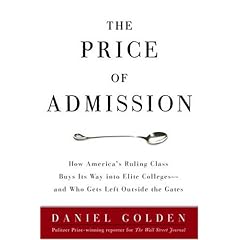 You would be right if you think you see a silver spoon on the cover of this book. It has been out about a year now. It is The Price of Admission: How America's Ruling Class Buys Its Way into Elite Colleges -- and Who Gets Left Outside the Gates, by Daniel Golden.
 This is part of a review for the Washington Post's Book World by Jerome Karabel :
"That virtually all elite private colleges give preference to the sons and daughters of alumni will come as a surprise to no one. But preference also extends to wealthy applicants whose families have been identified as potential donors -- "development cases" in the parlance of the trade. Golden documents that even Harvard, with its $25.9 billion endowment, is not above giving preference to the scions of the super-rich. His primary example, however, of development cases being central to the admissions process is Duke, where the university embarked on a systematic strategy of raising its endowment by seeking out wealthy applicants. Golden estimates that Duke admitted 100 development applicants each year in the late 1990s who otherwise would have been rejected. Though this may be something of an extreme case, special consideration for applicants flagged by the development office is standard practice at elite colleges and universities.
Also enjoying substantial preference at elite colleges, both public and private, are varsity athletes. In a fascinating case study of women's sports at the University of Virginia, Golden shows how the effort to comply with Title IX, a gender equity law that has the praiseworthy goal of ensuring equality between female and male athletes, has had the unintended effect of giving an admissions edge to female athletes who play upper-class sports. Between 1992 and 2002, the number of college women nationwide in rowing, a sport highly concentrated in private schools and affluent suburbs, rose from 1,555 to 6,690; more recently, the number of female varsity horseback riders increased from 633 to 1,175 between 1998 and 2002. The net effect of the rise of these overwhelmingly patrician sports, Golden argues, has been to further advantage already advantaged women.
A recent study by the Century Foundation estimated that only 3 percent of freshmen at highly selective colleges came from the bottom socioeconomic quartile, compared to 74 percent from the top quartile. Growing awareness of this shocking disparity has led a number of leading private colleges and universities, including Amherst, Harvard and Princeton, to take measures to increase the number of low-income students. But Golden is surprisingly ambivalent about these efforts, fearing (perhaps justifiably) that the admission of more poor and working-class students will be accompanied not by a reduction of preference for the rich, but by a decline in the number of middle-class students. The Caltech model that he finds so appealing is utterly inadequate to address the problem. Given the magnitude of class disparities in educational achievement, only affirmative action for the disadvantaged -- what former Princeton president William Bowen has called a "thumb on the scale" for low-income students -- promises to produce significant results.The Price of Admission estimates that the end of affirmative action for the privileged would open up roughly 25 percent of the places in the freshman class at elite colleges and, in so doing, free up spaces for aspiring students of modest origins. Based on my own research, I would estimate a figure of 10 to 15 percent -- still a considerable number. But the main beneficiaries of such a shift -- absent a more profound change in the prevailing definition of merit -- would not be the socioeconomically disadvantaged, but rather the children of the upper-middle class."
This Place
There is a wonderful book about the working class academics: This Place So Far From Home. It is a book of essays by working class people who find themselves in the foreign work of academia. A strange land, to be sure. Several of the essays remind me of trying to explain to my grandmother than just because I had a doctorate, I could not prescribe medicine for her aches and pains. The editors are C.L. Barney Dews and Carolyn Leste Law. Published in 1995 by Temple University Press. It's nice to read about a common experience.
Thursday, October 11, 2007
A Strategic Life
 A few days ago, I wrote a blog about volunteers. It was inspired by an incident at my school that involved a person in charge of a cushy assignment “volunteering” to do the assignment himself. Here are some other examples. At my school, because we do not hire people to teach what the students need, 5 people are now teaching two large first year sections. I think when we all agreed to do it, it could be legitimately be regarded as volunteering because it looked like it would be difficult. Now a few of us have decided it is a breeze. One prep and 6 or 8 hours of your teaching obligation is done for the year – hardly anything that should create in the School a need to “compensate” us in one way or another. But a person employing the volunteer strategy will continue "I am doing you a favor" charade. I do not know if anyone is in this case.
Here is another one. In my second year of law teaching I was on an 8 person appointments committee. At our weekly meeting it was announced that the budget allowed for 6 people to go to D.C. Now we all know that profs moan and groan about going to the meat market but they really love it – be a big shot for a few days, drink, clown around. So, at the meeting the Chair asked, “Who wants to go.” Not a single hand went up. At the next meeting the Chair announced that every person on the committee had contacted him privately to “volunteer” to go. Wanting to go created no implicit debt but a “volunteer” deserves something in return.
Where is this going? Actually I know and I may be manufacturing something here that does not exist at all. But, can the volunteer schitk be part of an overall pattern of professional strategic behavior? If it is, is it a law professor thing, an upper class thing or just something everyone does.
The overall strategy has three components. First is the voluteer. Second, you are always working hard and overburdened. Even if you just finished an hour of spider solitaire, webboggle, or surfing the net, when you come of your office you are in the midst of something pressing. So many things to do! Third, there is the “show no passion” strategy. Best to appear indifferent. Basic bargaining -- no one has any leverage with you when you do not care. Be sure to use words like “Aren’t you concerned about X” as opposed to “I really do not like X.”
Am I describing my school? Actually, I can only think of a few people that consistently fit the model and you would be hard pressed to convince me that my School is different from any other. Have I used these strategies? I am sure I have from time to time.
But think about the hell of keeping all of these going all the time. Such is the strategic life and my hunch is that it is a behavior found mainly among the privileged.
Thursday, October 04, 2007
Smile
Low socioeconomic class professors can experience one pleasure that is not available to their elitist counterparts -- out performing them or doing more with less. Not that all do but many do and I sense there is an underlying sense of pride when this happens. On every faculty I have served on there have been faculty members who did not have an elitist background and who ran circles around their colleagues. They overcame not only the initial prejudice in hiring but the documented biases of law reviews and a strong tendency by the elitist to discount their research. It has to be inferior, right? After all, they are not graduates of Ivy League schools.
I do not want to generalize too much here. It is not every elitist, by far, who wraps him or herself in the trappings of eliticity. On the other hand, I have heard that in actual experiments Harvard graduates mentioned that fact within, on average, 3 or 4 minutes of a new discussion. And, how many Ivy League law professors attempt to impress their classes by letting it "slip" that he or she is and Ivy League grad. My guess is that it is a high percentage.
But this is what really puzzles me. What exactly goes on at these elitist institutions? In my limited experience there appears to be no correlation between the level of elite education and the ability of a person to discuss art, music, history, or anything else. I could be wrong but, if not, is it possible they were so worried about grades that they forgot about the education itself. Or are these esteemed institutions simple selling repuation?
So you lower socioeconomic class achievers, stop feeling sorry for yourselves and feel sorry for your elitist colleagues. They can never experience of joy of doing it the hard way. Nor will they ever know if they could.
I do not want to generalize too much here. It is not every elitist, by far, who wraps him or herself in the trappings of eliticity. On the other hand, I have heard that in actual experiments Harvard graduates mentioned that fact within, on average, 3 or 4 minutes of a new discussion. And, how many Ivy League law professors attempt to impress their classes by letting it "slip" that he or she is and Ivy League grad. My guess is that it is a high percentage.
But this is what really puzzles me. What exactly goes on at these elitist institutions? In my limited experience there appears to be no correlation between the level of elite education and the ability of a person to discuss art, music, history, or anything else. I could be wrong but, if not, is it possible they were so worried about grades that they forgot about the education itself. Or are these esteemed institutions simple selling repuation?
So you lower socioeconomic class achievers, stop feeling sorry for yourselves and feel sorry for your elitist colleagues. They can never experience of joy of doing it the hard way. Nor will they ever know if they could.
Tuesday, October 02, 2007
Are Students Exploited?
My view is that a legal education is an enriching experience even if it does not turn into a $100k plus starting salary. For many students, though, I think it is an investment in human capital. Based on the entry level salaries and placement data it is hard to believe it is an investment that is justified by the rate of return. Yet, I hear little discussion of either decreasing admissions or even placing in the recruiting literature a disclaimer that law school may not be a life changing efforts -- for the better that is. Some of this can be found in US News and World Report but that data is questionable and the massive advertising and student recruitment budgets, even by public schools, are hardly full disclosure.
The reason, albeit not the complete reason, is that lower enrollments mean fewer jobs and if there is anything the privileged are entitled to it is a cushy job. The fact that thousands of law students may be burdened with debt is simply not part of the equation. So let me ask you this: If some portion of law teaching jobs are made possible because students with incomplete information go into debt, or forgo incomes, or have two jobs, is there a moral distinction between those making law school policy and the coal mine owners of say 1920?
The reason, albeit not the complete reason, is that lower enrollments mean fewer jobs and if there is anything the privileged are entitled to it is a cushy job. The fact that thousands of law students may be burdened with debt is simply not part of the equation. So let me ask you this: If some portion of law teaching jobs are made possible because students with incomplete information go into debt, or forgo incomes, or have two jobs, is there a moral distinction between those making law school policy and the coal mine owners of say 1920?
Friday, September 21, 2007
Prince Charles, Entitlement and Diversity
 I was just looking over Prince Charles' official website. (As far as I know he is not blogging, say, on moneyroyalty or prinzblog or any of the other blogs run by present, past, future, or pluperfect royalty. But think about it. Because some genes got mixed with some others we have the randomness of a Prince Charles. I have no reason to think he is not a humble guy and fully cognizant of the randomness of who we are and and even if we are. If he is about to be objective about himself he cannot have a sense of entitlement although I in fact I am sure he does. (Which raises the question at one level of whether all babies in hospital nurseries should be randomly handed out to parents so that each has a equal opportunity of having a decent family life, or we could just tax people on the basis of IQ.) Now switch to those in higher education who have a sense of entitlement -- as though they earned something -- when all they did was fall into the right gene pool and luck into the right parents. Crazy, isn't it for a kid with middle-class or higher parents, a high IQ, and a privileged upbringing to develop anything other than a profound sense of gratitude.
Who should have a sense of entitlement? The people least likely to have it. These are the people who overcame the lack of all those factors that those with a sense of entitlement seem to have. If those with no sense of entitlement were found more frequently in law teaching, the profession would be more diverse. In my own effort to increase diversity I think the first question to ask any faculty candidate is "What did your father do for a living."
Wednesday, September 19, 2007
Don't Get in a Fox Hole With an Elite
I really like John Kerry. Think he would have been a terrific President and respect his war record. But, if you have seen the news lately you have seen the tape of a University of Florida student being mugged by the UF police. It's grim and alarming. One only hopes UF does not have a real emergency.
The episode began with the student attempting to ask Kerry a question. As the police descended on him and pinned him and then tasered him, you can hear Kerry's voice in the background. "That is an important question," he says. "It deserves to be answered." As far as I can tell he does not shout STOP THIS or make any truly assertive move to intervene.
I could not help but think how much this is what one expects from an elitist. As I have written before, elitist rarely show passion or an inclination to get involved. (I am not sure they have the capacity to.) Showing passion would mean someone would know you feel deeply and it would also expose a weak spot to foes. The elitists are ultimately bystanders.
The episode began with the student attempting to ask Kerry a question. As the police descended on him and pinned him and then tasered him, you can hear Kerry's voice in the background. "That is an important question," he says. "It deserves to be answered." As far as I can tell he does not shout STOP THIS or make any truly assertive move to intervene.
I could not help but think how much this is what one expects from an elitist. As I have written before, elitist rarely show passion or an inclination to get involved. (I am not sure they have the capacity to.) Showing passion would mean someone would know you feel deeply and it would also expose a weak spot to foes. The elitists are ultimately bystanders.
Sunday, September 16, 2007
Are the Taking Rules the Same?
Several years ago, some lines from another law professor’s scholarship were discovered in a former colleagues own scholarship. My former colleague was not a popular guy and was not a household name. He was a very hard worker and terrific thinker. He lost his job and, to my knowledge, has not found comparable employment. I had no doubt that it was inadvertent. He tended to write everything on note cards and then incorporate it into his work and one thing led to another. Plus, as much as law professors are interested in whether they are cited, wouldn’t it be crazy to lift from their work?
If you have been in this business long you know the importance seeking out the other side of the story and getting the facts straight. Nevertheless, as I recall, the work or language of others has been found things written by Lawrence Tribe and, now, Ian Ayres (see today’s NYT’s book review section). In England, fiction writers Julian Barnes and, again, if my memory serves, Ian McEwan, have also had the words of others show up in their own work. Although McEwan and Barnes seem to argue that lifting from others was standard procedure, in the case of law professors I do not see how it can be anything but carelessness. It’s not, as if Tribe and Ayres need outside assistance when it comes to writing or ideas. Nor are the pressed enough for publicity to not be careful.
So what are the rules with respect to inadvertent copying? And are they different depending on how much people are liked or how high they are placed? My very small sample suggests they are.
If you have been in this business long you know the importance seeking out the other side of the story and getting the facts straight. Nevertheless, as I recall, the work or language of others has been found things written by Lawrence Tribe and, now, Ian Ayres (see today’s NYT’s book review section). In England, fiction writers Julian Barnes and, again, if my memory serves, Ian McEwan, have also had the words of others show up in their own work. Although McEwan and Barnes seem to argue that lifting from others was standard procedure, in the case of law professors I do not see how it can be anything but carelessness. It’s not, as if Tribe and Ayres need outside assistance when it comes to writing or ideas. Nor are the pressed enough for publicity to not be careful.
So what are the rules with respect to inadvertent copying? And are they different depending on how much people are liked or how high they are placed? My very small sample suggests they are.
Monday, September 10, 2007
Wired
Here is an interesting article about how law review editors select articles. As you would expect institutional authority -- credentials and prior placements -- are very important. Not surprising.
http://www.stthomas.edu/law/faculty/bios/pdf/articleselectionchristensen.pdf
It seems clear that hiring is not quided by moneylaw priciples. Nor is the selection of articles. Is anything in law teaching not wired? More importantly, what would a moneylaw system of law reviews look like?
http://www.stthomas.edu/law/faculty/bios/pdf/articleselectionchristensen.pdf
It seems clear that hiring is not quided by moneylaw priciples. Nor is the selection of articles. Is anything in law teaching not wired? More importantly, what would a moneylaw system of law reviews look like?
Wednesday, September 05, 2007
People's History
 Jim Chen's post on MoneyLaw about the language as an identifiers, a New Yorker article on micro burst expressions several years ago, Wolf's, Radical Chic, Zinn's History, and my own posts some time ago on 1) signaling and 2) that I am not convinced that Law Schools are really interesting having faculty who are both African American and diverse all seem to come together.
Can I tie altogether in a blog length post. Not a chance, but here is where it ends up. As a totally amateur sociologist I sense that elitist dominated hiring committees feel comfortable with candidates in the following order:
1. White elitist educated male
2. White elitist educated female
3. African American elitist educated male
4. African American elitist educated female
5. White non elite female.
6. White non elite female.
7. Non elite African American female
8. Non elite African American male.
First note that elite always trumps non elite. Second, Committees like 1s and 2s because they have more in common with those folks and they will find room for 1s and 2s.
 They will also, in the quest for non diverse diversity, search high and low for 3 and 4. I am not saying 3 and 4 are always not diverse. Maybe they are faking for sake of the interview but my sense is that, the less diverse they seem, the higher their ranking and some do not seem to have to try very hard to seem not diverse. I actually feel for these candidates. Many have the street creds of Mr. Rogers but they have to please everyone. A smattering of people on a faculty looking for "deep" diversity may be put off by too much cozying up to the 1s and 2s by the 3s and 4s. On the other hand, it is important to please the 1s and 2s.
Now we get down to 5-8 and Howard Zinn. You know the story -- whether the American Revolution, the Civil War or Viet Nam-- the elites take care of their own and they use the non elites to get there whether it means using them to fight their battles or pitting them against each other.
Is law school hiring Zinn's version of history playing out in a different context. Why wouldn't it be?
Irrational Hiring
Over on Moneylaw I described the outcome of an empirical study comparing the output of scholarship of elite and non elite law school grads who are now teaching at mid range law schools. In another post I listed some of the arbitrary decisions one must make in attempting an effort like that. Although I plan to redo the study and attempt to refine it the bottom line is that there is virtually no difference in the quantity of scholarship produced by those with highly elite credentials and those with out. This means that those law school hiring committees that allow themselves to be swayed by the school from which a candidate graduated are relying on a short cut that has no particular meaning and, frankly, are being lazy.
The study considered only 4 mid level schools for two reasons. First, I wanted to hold constant for the school at which the prof teaches. Second, it is hard to find non elite grads at highly ranked schools.
The study considered only 4 mid level schools for two reasons. First, I wanted to hold constant for the school at which the prof teaches. Second, it is hard to find non elite grads at highly ranked schools.
Thursday, August 30, 2007
Hiring Biases -- Yet Again
 It's law school hiring time and nothing much changes. My impression is that the hottest entry level candidates are those with elite degrees and Supreme Court clerkships. In fact, these candidates often do not make it it the AALS convention. Next are the top ranked grades of elite law schools.
While I do not know that those people turn out to be more productive than others and I can think of examples when they have not, it seems to me that the more crucial issue for a mid or lower level law school arises with respect to the next level of hiring. The choice for these schools is between second tier elite school graduates and the top graduates from non elite schools.
I do not know what every school does when faced with this choice but my impression is that a fair number of them go for the second tier elite school graduate. What I do know is that this bias cannot be based on any empirical comparison of the productivity of second tier elites and top tier non elites. No, it's purely self-referential hiring because God only know what would happen if the top ranked non elites were hired and out-shined the elite. We couldn't have that, now could we?
Subscribe to:
Posts (Atom)