I am not sure I agree but here comes another indicator of how class differences are manifested and, to some extent perpetuated. In a recent article Michael Kraus and Dacner Keltner describe different body language tendencies that are correlated with class. Here is part of their summary (the link above is to a short article about the article, not the original)
"Informed by recent advances in person-perception research,
and theoretical analyses of resource dependence and power, we
examined how SES is signaled in a face-to-face interaction. Our
first prediction was supported. SES was reliably associated with
a set of nonverbal cues: Upper-SES individuals exhibited more
disengagement and less engagement during a get-acquainted
interaction than did lower-SES individuals. Our second prediction
was also supported. Naive observers reached consensus
and identified participants’ family income, maternal education,
and subjective SES with greater-than-chance accuracy, despite
being exposed only to participants’ behavior during the get acquainted
interactions. Finally, these naive observers based
their judgments of targets’ SES—and rightly so—on targets’
disengagement- and engagement-related nonverbal behavior.
This study is the first to reveal relations between SES and social
engagement, and it is the first to show that SES can be readily
‘‘thin sliced’’ by naive observers."
What this means is that upper social class people have learned to signal their elite status by seeming to be disengaged, even bored, by others. This is especially true when getting acquainted because relative status has yet to be established. The authors suggest that the difference in behavior is an indicator that one is of high enough status that no approval of others is necessary. I'd say this reflects what I have described before as playing it close to the vest and revealing no emotions. Smile and nod too much and someone may think you are from a lower class. Be stuffy, and you are golden!
Friday, February 13, 2009


Monday, February 09, 2009
Law Suit
Several readers have asked if I am going to blog about the pending law suit against UF and the Law School that Paul Caron has publicized.
I really cannot. I have thankfully been out of the loop on virtually all of the details. This is a huge Law School and I doubt very seriously that one person's take would be accurate.
I really cannot. I have thankfully been out of the loop on virtually all of the details. This is a huge Law School and I doubt very seriously that one person's take would be accurate.
Monday, February 02, 2009
Privatizing Social Capital
 A couple of years ago over on money law I wrote a blog on making nice and doing nothing -- a common trait of the elites. Now it occurs to me that it is a great example of capitalism only the capital is social.
Let me provide some background. In the higher education contexts in which I have participated, there is always a subtle form of extortion. People can disagree but they never show exactly how much something really matters because if he or she does that to the point of causing discomfort, there are sanctions ranging from being the subject of gossip to being discounted or socially ostracized completely. When this happens -- pushing hard enough to make someone uncomfortable -- social capital is used. Kiss enough butt or scratch enough backs and you and regain some of it.
Discomfort is the operative concept here. Make enough people uncomfortable and you use up all your capital. Also we are not talking about right, wrong, truth or beauty. Even pushing the most dead solid truth or good cause can lead to discomfort. Never use social capital and you are completely ineffective. Use it all up and you are equally ineffective. I know people at both ends of this continuum.
There is another continuum as well and this is defined by how you use the capital if you choose to use it at all. You can use it for yourself -- complain about a teaching assignment, fight for your favorite program or more travel money because, afterall, you are special and doing God's work -- or you can use it for others -- a change in law school policy in which self-interest is not involved.
You could graph all this and if I knew how I would. The horizontal axis from left to right would be not willing to use social capital to very willing to use social capital. The vertical axis would be from bottom to top, use social capital for self and use social capital in matters in which there is no self interest.
Now we could take each person and put a point on this grid and the all four quadrants would have some points. Just for orientation sake, the bottom left quadrant would be little use/ but personal use when used. In this quadrant you find many law professors. I would say "most" but that would mean over 50% and I am not sure. But if you had to pick one quadrant and put $5.00 on it, that would be your best bet. They hoard social capital and spend it one themselves.
I think there is some sociological literature to the effect that this behavior is very common among the upper classes and it is critical for a someone trying to climb the ladder to stay solidly in that bottom left quadrant -- or at least appear to be.
Sunday, February 01, 2009
Class Bias in Practice

The term "class bias" like many others has an idea or theory behind it but is not really brought home until you see it in practice as I have over the last few months. In the midst of my University's huge budget cuts, the Law School has avoided any cuts at all. It has done this by raising tuition and cutting class size. Some faculty feel shame at the idea of eliminating 25% of the students while increasing the law school budget and faculty size while the rest of campus suffers. Some feel it is simply a way to up the US News ranking by lopping off the bottom of those admitted. I hope not but this will depend on admissions practices which have not revealed themselves yet.
Still the idea of fewer students and higher tuition is not unreasonable. Fewer students can mean lower class size and, since our tuition is very far below the average, raising it, while unfortunate for students, does mean that those who benefit from the Law School pay a bigger part of the cut. It also lowers the stress on taxpayers most of whom are less able to pay than the students and their parents.
So where is the class bias? While law faculties grant tenure to the children of privilege year after year without a serious inquiry into whether they deserve a live time job and continue to hire even more of the privileged, they ignore the plight of maintenance workers, secretaries and year to year contract people are on the chopping block.
To be fair, a few have volunteered to teach extra in order to decrease the need for new hiring under such extreme conditions. But, for the most part there are excuses -- how do we know where the money will go? It's important to grow the law school, etc. And there are leaders who want to be able to take credit for steering us through hard times. Those negatively affected by this tunnel-vision will be unheard from when the "credit taking" occurs.
And finally there is the tendency to become company men and this I cannot claim to be class based. To understand what I mean think of the last time you had any kind of complaint about a product or service and had to interact with a clerk who immediately became defensive on behalf of the company. So too with faculty. At some point the goal is not to do good but to protect the School or a program regardless of what it is doing. Having always been an outsider, I'll never understand the transformation to company man when the company has gone astray.
Consistent with my New Year's resolution to be too quick to judge, I've searched for a charitable interpretation of events but cannot come up with one. If there is one, I'd like to hear it. But that would violate another rule the privileged go by: To engage on an issue is to concede there may be two ways to look at it. So, do not engage.
Thursday, January 29, 2009
Phil Ochs, Limousine Liberals and Going Green
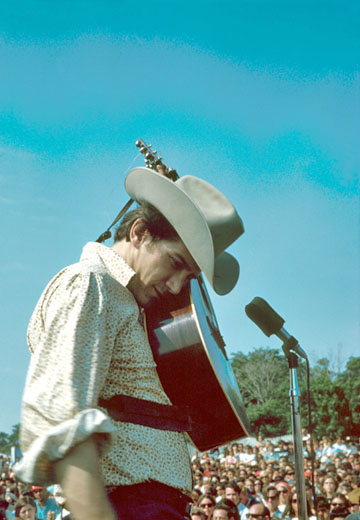
In a comment too rich to be relegated to a comment, Professor Eric Fink of Elon College, who has his own most excellent blog, reminds you -- not me because I never knew -- that Phil Ochs captured the notion of a liberal years ago with the observation that liberal means: "Ten degrees to the left of center in good times. Ten degrees to the right of center if it affects them personally." I'd say that pretty much captures most law professors and my description of events at my school in the post that is immediately below this one.
The frequent complaint is that there are very few conservative or libertarian professors or, put differently, too many liberals. There are too few conservatives and libertarians for most law faculties to be intellectual interesting but tenure sometimes solves that as closet doors open. Perhaps an even better case can be made that there are practically no law professors whose views represent the left. One indicator of having some leftist leanings is a willingness to talk about class but law professors rarely go there. As my friend once said, "Discussions of class are too close to the bone."
I think the appropriate term here is limousine liberal. I've thrown the term around not really knowing how it originated so I googled it. At least one view is that it originated with the 1969 mayoral race between Lidsay and Procaccino.
One of the more bizarre illustrations of limosine liberalism (a term that I now think is redundant) involves the purchase by supposedly greens of pollution rights. It's a crazy combination of the Coase Theorem and limousine liberalism. Feel guilty about driving your SUV, limo or flying the private jet? Just buy some carbon credits. No less pollution but someone else pollutes less so you can. Is this something like paying someone to take your place in the army? So, as I understand it, it's OK to pollute as long as you win the right in an auction. Guess who wins those auctions -- money counts, not need. Duh, doesn't it make more sense to buy them and not use them?
Tuesday, January 27, 2009
Liberal For You; Conservative for Me: Public Law School Financing
 Those who study regulated industries know that regulatory bodies are less concerned with how much a utility spends than with how much is passed through to rate payers. This "above the line/below the line" idea applies in many, but not all, respects to higher education. State legislators are less interested in how much is spent by a University than they are about how much of that cost is passed through to taxpayers.
What this means is that one solution to budget cuts is simply to decrease class sizes (less demand for state funding) and raise tuition (to maintain the status quo). For a University unit, like a law school, that has the principal goal of maintaining the status quo or even expanding while so many others cut back, it works out fine. Of course there must be an agreement that the tuition raising unit gets to keep the tuition hike so, as one administration puts it, "dollars generated are returned to the benefit of the college whose students paid those dollars" -- to say nothing of the faculty and the programs they favor. This sounds a great deal like the idea that law schools should do what benefits those who pay the bills. Yes, the stakeholder/fiduciary duty model appears but only in a limited way -- very little mention is of made of taxpayers who still pay most of the tab.
This is a highly popular strategy for the faculty-beneficiaries but raises a number of questions. If that is the approach one takes to higher education, it means shutting down or downsizing departments whose students do not generate sufficient revenue. Good-bye humanities; hello giant classes. (Now, we don't want that do we? On the other hand, someone else should pay, right?)It's a very conservative view and completely at odds with the idea that some units of the system should cross-subsidize other units or even that tax payers should subsidize anything. Here again the public utility analogy comes into play. Most of those opposed to cross subsidizing others in the University probably think it is a great idea for taxpayers to pay their salaries and, in the case of utilities, for example, for some rate payers to pay more to subsidize life line rates for poorer rate payers. It is the "liberal when it comes to your pocket book and conservative when it comes to mine" philosophy of the elitists who control higher education.
Of course there is a possible extension of this new conservatism and that is privatization. The new approach is one that embraces privatization as long as it is beneficial to law teachers. In short, there is no principle involved, just the idea that a bit of conservatism is not so bad as long it means preserving the ends -- us.
Wednesday, January 21, 2009
Whose Gravy Train is This?
 Over on Moneylaw there is a terrific new post asking if the gravy train is over for law professors. I doubt it because so many law professors are blinded their sense of self importance and trained to be successful advocates especially when they are their own clients as so many are everyday.
In the Moneylaw post, my old Dean, Rick Matasar is quoted as saying, "We are an input-focused business, and outputs are what the students are paying for. . . . Law school needs to be about what people need -- not what we're good at. ... Most of us are social misfits, and we're the ones who've been designated to teach the students how to work interpersonal skills. . . .We should be ashamed of ourselves. We own our students' outcomes. We took them. We took their money. We live on their money to pay to come to San Diego. And if they don't have a good outcome in life, we're exploiting them."
His reference is to the latest law professor convention in San Diego and I think his comments need to be amended a bit for those of us teaching at public schools.
I agree with Rick on much of this but feel he has underestimated the problem. It is true that law professors focus on inputs --- how else can narcissistic hiring policies be explained. They also focus on outputs. The problem is that the chief output is law professor well-being. Thus, the students' money as well as that of other stakeholders is taken to advance the ends of law professors. How else explain the constant angling for low teaching loads, caps on class sizes, two-day a week teaching schedules and machine graded multiple choice exams?
Right now, even though applications may fall, the number of people who want to go to law school far out strips the number of seats available. As long as that holds true, the gravy train will continue even if it means admitting and graduating poorly qualified students who will fail the bar or fail their clients. The gravy train will only end -- and only then for the lowest ranked schools -- when demand falls so much that no amount of foraging for students will fill the seats. Only then will outputs become important because then the real output "professor well-being" will be threatened.
Thursday, January 01, 2009
The Law School Football Team

From time to time a law professor at another school writes to me rather than comment on a post. Here is part of an email from what I assumed to be a first or second law professor. He or she had just come from an appointments meeting at which a number of candidates were discussed.
"I assumed that the hiring meeting would show me that people took the hiring process seriously. While this was certainly true of a number of people on my faculty (I suspect a majority), others really surprised me. Lessons that I learned from the faculty meeting (based on oral comments at the meeting rather than the vote itself):
1. scholarship matters except for when you like a person
2. the job talk matters except when you like a person
3. when you don't like a person, you say it indirectly ("something does not seem right about them" without explaining what it is)
4. scholarship matters except when you don't like the person
5. written faculty comments on the visit matter except for when they do not
6. we arbitrarily either count or discount practice experience based on how much we like the candidate."
Note that "like" a person plays a role in 5 of the 6 rules. I wonder how the rules might apply to selecting members of a football team.
1. Wide receiver speed matters except when you like the receiver.
2. The punter's hang time matters except when you like a person.
3. When you do not like a lineman say it indirectly. ("Something about his stance just does not seem quite right.")
4. The quarterback's accuracy matters except when you don't like the person
5. What the experts think matters except for when they don't.
6. Past yards per carry for a running back either count or are discounted based on how much the candidate is liked.
Pretty crazy way to pick a football team right? The team would lose every game. Is there any reason to think the "like" factor is different for law faculty success. At least in football there will be an objective measure of success and an opportunity to cut players. In law school hiring there are no measures and the initial hiring decisions are for lifetime jobs.
What the young law professor described at his school sounds like a great approach if you are deciding who you want to go down to the bar with after school for a drink. It's a disaster for the stakeholders of a law school.
Note that "like" a person plays a role in 5 of the 6 rules. I wonder how the rules might apply to selecting members of a football team.
1. Wide receiver speed matters except when you like the receiver.
2. The punter's hang time matters except when you like a person.
3. When you do not like a lineman say it indirectly. ("Something about his stance just does not seem quite right.")
4. The quarterback's accuracy matters except when you don't like the person
5. What the experts think matters except for when they don't.
6. Past yards per carry for a running back either count or are discounted based on how much the candidate is liked.
Pretty crazy way to pick a football team right? The team would lose every game. Is there any reason to think the "like" factor is different for law faculty success. At least in football there will be an objective measure of success and an opportunity to cut players. In law school hiring there are no measures and the initial hiring decisions are for lifetime jobs.
What the young law professor described at his school sounds like a great approach if you are deciding who you want to go down to the bar with after school for a drink. It's a disaster for the stakeholders of a law school.
Wednesday, December 17, 2008
Outliers, Class and Law Professors
Malcolm Gladwell's newest book, Outliers, is an interesting read. It is devoted to the reasons some people succeed and some don't. The reasons are often not what you would expect. On the matter of class, he captures the difference in impact "wealthier parents" and "poorer parents" have on their children very nicely. He sums up his discussion with "the sense of entitlement that has been taught is perfectly suited to succeed in the modern world."

Those who are intrigued by class differences will not be surprised. The wealthier parents encourage all kinds of special activities, have interesting reading material around the house, encourage their kids to speak up on their own behalf, etc. He quotes sociologist Annette Lareau as follows, "Even in fourth grade, middle class children appeared to be acting on their own behalf to gain advantages. They make special requests of teachers and doctors to adjust procedures and accommodate their desires."
Again, although there is little that is surprising here, I was reminded how institutionalized the "special requests" have become when I visited my son's school to pick him up after an exam that ended at 11 AM. I came across a room full of kids still taking the exam at 11:30. He was not among them. I asked if the test had run over and the answer was "No, those are all the kids who get extra time for one reason or another." And then the teacher added, "For a couple of thousand dollars evidently anyone can have a child diagnosed with something that results is extra time." Yes, the teacher was describing yet another market the wealthy visit far more than the working class -- the market for the disability advantage. In the room were kids with real disabilities and then kids who parents bought them a ticket for more time. (If you are wondering, in the article discussed in the post below, it is noted that "extra time people" score significantly higher on the SAT than others.)
The second thing that struck me about Gladwell's description is how much the entitled children behave like life is a zero sum gain. They "act to gain an advantage." Nowhere in his description of the lives of wealthy children is there a word about teaching empathy or even that one's efforts to gain an advantage usually mean leaving someone else with less. I suppose that type of consciousness is actual a form of disability.
Finally, although it goes without saying, Gladwell has perhaps unknowingly described something about law faculties. There are, of course, very few people on law faculties without the sense of entitlement he describes. For the average entitled law professors asking or demanding special treatment causes no angst because whatever is wanted is deserved. For the handful law professors who do not feel so entitled, asking for anything special is a struggle and they are still, to their disadvantage, under the impression that special treatment is something that is earned.

Those who are intrigued by class differences will not be surprised. The wealthier parents encourage all kinds of special activities, have interesting reading material around the house, encourage their kids to speak up on their own behalf, etc. He quotes sociologist Annette Lareau as follows, "Even in fourth grade, middle class children appeared to be acting on their own behalf to gain advantages. They make special requests of teachers and doctors to adjust procedures and accommodate their desires."
Again, although there is little that is surprising here, I was reminded how institutionalized the "special requests" have become when I visited my son's school to pick him up after an exam that ended at 11 AM. I came across a room full of kids still taking the exam at 11:30. He was not among them. I asked if the test had run over and the answer was "No, those are all the kids who get extra time for one reason or another." And then the teacher added, "For a couple of thousand dollars evidently anyone can have a child diagnosed with something that results is extra time." Yes, the teacher was describing yet another market the wealthy visit far more than the working class -- the market for the disability advantage. In the room were kids with real disabilities and then kids who parents bought them a ticket for more time. (If you are wondering, in the article discussed in the post below, it is noted that "extra time people" score significantly higher on the SAT than others.)
The second thing that struck me about Gladwell's description is how much the entitled children behave like life is a zero sum gain. They "act to gain an advantage." Nowhere in his description of the lives of wealthy children is there a word about teaching empathy or even that one's efforts to gain an advantage usually mean leaving someone else with less. I suppose that type of consciousness is actual a form of disability.
Finally, although it goes without saying, Gladwell has perhaps unknowingly described something about law faculties. There are, of course, very few people on law faculties without the sense of entitlement he describes. For the average entitled law professors asking or demanding special treatment causes no angst because whatever is wanted is deserved. For the handful law professors who do not feel so entitled, asking for anything special is a struggle and they are still, to their disadvantage, under the impression that special treatment is something that is earned.
Friday, December 05, 2008
Over Parented (or is it Parenting) Law Professors
 There was an extended book review/ article in the New Yorker a few weeks ago about over parenting and how it can result in a fairly inept adult. Over parenting, if you unfamiliar with the term, is the largely upper middle class tendency toward making sure a child never experiences a sense of not succeeding. This means the child spends his or her life in a protective bubble that hardly prepares him or her for life.
Over parenting has clearly hit law schools. At mine, untenureds are given the first and every other summer off with pay, assigned multiple mentors, and have teaching assignment tailored so they can write. I doubt it is much different at other law schools.
At first, I thought these changes were a reaction to the first wave of over parented kids becoming old enough to be law professors. In effect, their protective bubbles would continue at least until the point of being tenured which, then, is like a life time protective bubble.
This model did not fit the actual individuals hired since they seem, to me at least, to be pretty adept at dealing with life and the job. In fact, a couple have confided that what I am calling over parenting makes them uncomfortable. It would drive me crazy.
I realized then the problem may not be with the untenureds at all. Isn't it more likely that the impetus comes not from the parented but from the parenters? It seems increasingly clear that overparenting adults cannot distinguish between their own children and people who they relegate to the status of children in the work place. In the case of conventional over parenting, those engaged may get something out of it that goes a bit beyond love and caring. Or, if it is only love and caring, it is the type of smothering that eventually hurts the person who is loved.
What we will not know for a few more years is whether over parenting of untenured law professors will be as disabling as it is for children.
Wednesday, December 03, 2008
Are Law Schools Recession Proof?
 The pecking order at law schools is pretty well set. First are the tenured professions then the tenure track but yet to be tenured. Next, oddly enough are the yet to be hired untenured people. After that are year to year, untenured people who typically teach skills courses. Then secretaries of various sorts and finally the maintenance crew. I suppose actual and potential students fit in here somewhere and I am inclined to say at the very bottom.
When budget cuts come, the ordering of cuts can follow the ordering but in reverse. A school may or may not save money by reducing its enrollment. If it can, the potential students will be first to have opportunities removed. Next up the line in terms of vulnerability are the people who earn the least and, thus, can least afford to lose their jobs.
Law school policy, even with respect to budget cuts, is largely faculty driven. Perhaps a test of the character and humanity of the faculty of a law school is how it deals with cuts. For example, if it is possible to preserve opportunities for students or the jobs of those at the bottom of the pecking order, are those at the top willing to teach extra hours or courses that are not their main interests. Are they willing to open classes they do teach to greater numbers of students? Are there programs that seem to have outlived their use that could be eliminated? These things mean reducing the need to replace retired professors with new ones or with visitors.
Only in the rarest of instances are tenured law professors likely to have their job security threatened by economic conditions. Their decisions, however, do affect the job security of others. Maybe they are not the Godfathers of those lower in the pecking order but they have the capacity, if they care to, to soften the blow of economic hard times.
Thursday, November 20, 2008
The Common Thread

One debate that I have each year (and lose) concerns the fascination law school hiring committees have with candidates with elite credentials. Schools at the level of mine and lower only rarely attract candidates who graduated from top ranked schools at the top of their classes. Thus, the decision is between lower (and sometimes very low ranked) graduates from elite schools and the tip top graduates from other schools. By "other schools" I do not mean bad ones. No, I mean ones maybe just outside the top 10. Still, it continues -- the brand name trumps almost every other indicator of intellect and work ethic.
This is not a matter of relying on an accurate indicator of success. A little study I did last year indicated that elite grads at mid level schools are no more productive than the hand full of non elite grads. In addition, on average I think elite grads are less well educated that non elite grads who end up teaching at mid level schools. The elites (again, on average, not uniformly) seem to be narrowly educated. Very few seem to be able to talk about art, history, politics or any thing other than a very narrow range of topics. (They also seem relatively humorless -- not an irreverent bone to be found -- but that is another story.) They seem more technicianish.
I did a little study of all this with the goal of determining why non elites seem seem have more going for them than the elites. The only factor I have been able to come up with so far is that the non elites in legal education are very likely to have been, as children, and continue to be voracious readers. They are basically self-educated. Elites can also be voracious readers and self-educated but they do not have to be to be law professors.
This means a number of things but the most important thing is that somewhere somehow, hard-wired or socialized, they were intellectual curious. Learning itself was a reward and not because to meant getting an A or performing well as a "trophy child."
So, if I were on a hiring committee, what I would ask in addition to the lists I have posted before that were designed find to lower socioeconomic class people would be:
1. What was your favorite book at age 15.
2. What were the last 10 books you read that had nothing to do with law.
3. Name your favorite opera, aria, symphony or any non pop, folk, alt music.
4. Who was your favorite teacher before law school and why?
and finally,
5. How would a Rawlsian design the faculty recruitment process?
Wednesday, November 05, 2008
O'Conner and Nader, Eight Years Later
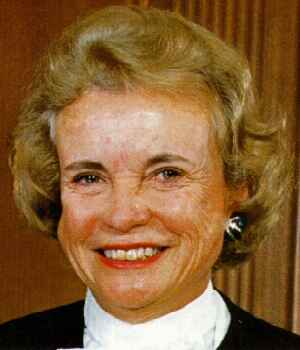 I am not sure it is possible to have less respect for former Justice O'Connor than I do. If the newspaper reports are right she was stunned that her retirement might be delayed by a Gore victory. Think of the sense on entitlement to think you should determine who replaces you. And thing of the lack of principles among those Justices who supposedly deferred to State processes until it came to Bush v. Gore. Finally, think of the hypocrisy of law faculties who hated her opinion and understood the lack of principle but have toasted her and fawned over her since her selfish action.
But ultimately is she any worse than the Nader voters who essentially gave the election to the Frat Boy President? In fact, had they not cast their petulant votes, the O'Connor issue would not have arisen. It is too strong to say they have blood on their hands but their carelessness can be traced to suffering of thousands.
It will take years to pull out of the eight year nightmare but for the first time in eight years I do not feel like I have to explain myself and the US when in the company of foreign friends. Finally, I can repeat to the truly upset McCain/Palin/NRA/Swiftboat people a phrase that was popular years ago and addressed to me: My country, Love it or leave it.
Tuesday, October 28, 2008
Germany? 1930s?

It is sinister. Dark skies and a stormy ocean. An announcer warning against a nation in hard times turning to (or is that overtaken by) an unknown leader who has experienced a "quick rise to power." "Rise to power" -- what a frightening and evocative phrase. It makes one think of dictators and kings. What are you thinking about? Germany? 1930s?
Wrong, it is the latest McCain ad. "Rise to Power" must be in honor of Halloween. It reminds me of the TV ad for I do not know what product that has the baby who made enough money to hire his own clown. He says he had underestimated the creepiness. I have always regarded clowns as creepy. On the other hand, I did not realize that a political ad could be creepy. Not, at least since the hydrogen bomb was shown just behind fair-haired Sue in 1964.
To me, Rise to Power goes right to the top or bottom along with both the anti Goldwater ad of the sixties and Willie Horton.
Thursday, October 23, 2008
Support for the Sarah Voters
 Today I voted in Florida. The act of voting here increases the probability that your vote will count
But to the topic of this post:
No I do not support her. I have already stated that to me Sarah Palin is like 10,000 finger nails scraping along a black board or 1000 cars with mega basses tuned up to brain damage level surrounding me at a stop light. And, I still think her selection is one of the all time most cynical political acts I have witnessed. Really, it is like John "I am so Mad" McCain has told the American voters what he thinks of them and it isn't a good thing and they have taken it as a compliment. (But is it cynical if he is right?)
But the Sarah voters have earned your respect if they vote for her just because they like her. Does that put personal comfort ahead of the welfare of the country? Yes but who cares? Or more specifically don't complain if it is what you do. I have witnessed many many faculty votes and discussions about hiring, tenure, promotion, and salary in which the likability factor dominated. Questionable teaching, borderline scholarship, and concerns about law school stakeholders are ignored or explained away if the candidate is likable enough.
If this were a Budweiser radio commercial I can hear the "real men of genius" theme playing and the salute to those who vote for friends beginning. Right there along with "rolling cooler roller man" and "scoreboard marriage proposal man."
And now the best news of all. Many law professors have something else in common not just with the Sarah voters but with Sarah herself. Yes, it appears her family vacations are timed when she is on "state business" and, guess what, the whole family goes on the state's tab. Does this reflect a sharing of principles that could finally convince some law professors to move over to the Sarah column?
Wednesday, October 15, 2008
Is the Dachshund a Working Class Dog?

I always thought so. I mean how could any self respecting elitist own a dachshund when he or she could have a golden retriever. Or maybe the working class dog is really a tiny poodle.
Now I have to rethink the dachshund after reading this Don Burness Poem from Brutal as All Olympics Are.
The Meaning of Life
The painter Bonnard knew
Picasso and Andy Warhol knew
Henry James knew
Dorothy Parker knew
P.G. Wodehouse knew
E.B. White knew
Queen Victoria surely knew
And I know
and I taught my students
that the meaning of life
is
the dachshund!
Thursday, October 09, 2008
Bitter Hearts: Stephen Crane and Donald Burness

One of my favorite poems is by Stephen Crane:
The Heart by Stephen Crane
In the desert
I saw a creature, naked, bestial,
Who, squatting upon the ground,
Held his heart in his hands,
And ate of it.
I said, “Is it good, friend?”
“It is bitter - bitter,” he answered;
“But I like it
Because it is bitter,
And because it is my heart.
Somehow when a friend who always prefers not to be mentioned by name referred me to this poem about academics, I thought of the Crane poem. This one is by Donald Burness and can be found in his collection, Brutal Like All Olympics Are.gnathonic toads infesting fleas
this is the tribe of my enemies
joyless drones self-righteous frauds
they honor each other with false applause
jealous knaves consumed by hate
ever eager to extirpate
dull lifeless they cannot soar
on winds of dancing metaphors
what a paltry pathetic thing
to honor Mediocrity as your king
and when the king lets out a fart
they love the smell with all their heart
I wish them scrofulous days ahead
and may they rightly be remembered
as zeros when they're dead
Burness is angry about the people he dealt with in academia. I do not feel nearly as strongly in part because to be that bitter you have to take them seriously. And, for my taste his brush is too broad. Still, for anyone in the college teaching business, things like "false applause," "joyless drones," "Self-righteous frauds," and "mediocrity as your king," must ring some bells.
Monday, September 29, 2008
Are One Chance Students the Victims of Unlimited Chance Professors?
 In the last two posts I presented excerpts from The Disadvantages of An Elite Education by William Deresiewicz.
Perhaps the most powerful observation from that article follows:
" . . . [T]he way students are treated in college trains them for the social position they will occupy once they get out. At schools like Cleveland State, they’re being trained for positions somewhere in the middle of the class system, in the depths of one bureaucracy or another. They’re being conditioned for lives with few second chances, no extensions, little support, narrow opportunity—lives of subordination, supervision, and control, lives of deadlines, not guidelines. At places like Yale, of course, it’s the reverse. The elite like to think of themselves as belonging to a meritocracy, but that’s true only up to a point. Getting through the gate is very difficult, but once you’re in, there’s almost nothing you can do to get kicked out. Not the most abject academic failure, not the most heinous act of plagiarism, not even threatening a fellow student with bodily harm—I’ve heard of all three—will get you expelled. The feeling is that, by gosh, it just wouldn’t be fair—in other words, the self-protectiveness of the old-boy network, even if it now includes girls. Elite schools nurture excellence, but they also nurture what a former Yale graduate student I know calls “entitled mediocrity.” A is the mark of excellence; A- is the mark of entitled mediocrity. It’s another one of those metaphors, not so much a grade as a promise. It means, don’t worry, we’ll take care of you. You may not be all that good, but you’re good enough."
What happens when unlimited chance people teach one chance people? They are likely setting them up for failure. Unfortunately, when law schools hire they salivate over elite, unlimited chance people who are likely to treat their one chance students as though they too have unlimited chances. As I have described over on Moneylaw, the effect is to create disabilities. When teachers have no deadlines, give out only high grades, and have low classroom expectations, they lead students to believe there are no consequences for being a slacker. That is true if mommy and daddy supply a life long safety net. But for students who are not similarly situated it can be a trap.
Friday, September 26, 2008
Does an Elite Education Produce Anti Intellectuals
In my previous post I quoted the initial two paragraphs of The Disadvantages of an Elite Education by William Deresiewicz. Maybe the most important passage of that article for those in legal education comes near the end.
"But if you’re afraid to fail, you’re afraid to take risks, which begins to explain the final and most damning disadvantage of an elite education: that it is profoundly anti-intellectual. This will seem counterintuitive. Aren’t kids at elite schools the smartest ones around, at least in the narrow academic sense? Don’t they work harder than anyone else—indeed, harder than any previous generation? They are. They do. But being an intellectual is not the same as being smart. Being an intellectual means more than doing your homework."
Deresiewicz follows this paragraph with a description of elite school students as roughly the equivalent of grade grubbing drones. My sense is that this is a relatively recent thing. At some point in time, attending an elite school could contribute to the development of real intellectual curiosity and a love for ideas. I am sure that still holds for many graduates of elite schools but that is more a testament to their resistance to the elite education than anything else. From my perspective, and it is an admittedly narrow one, I am surprised at how anti intellectual newer elite grads are, especially the double elites. In fact, in many instances they seem to have little or no knowledge of history, philosophy, art, etc. Nor do they find much that is interesting outside of their personal niche.
"But if you’re afraid to fail, you’re afraid to take risks, which begins to explain the final and most damning disadvantage of an elite education: that it is profoundly anti-intellectual. This will seem counterintuitive. Aren’t kids at elite schools the smartest ones around, at least in the narrow academic sense? Don’t they work harder than anyone else—indeed, harder than any previous generation? They are. They do. But being an intellectual is not the same as being smart. Being an intellectual means more than doing your homework."
Deresiewicz follows this paragraph with a description of elite school students as roughly the equivalent of grade grubbing drones. My sense is that this is a relatively recent thing. At some point in time, attending an elite school could contribute to the development of real intellectual curiosity and a love for ideas. I am sure that still holds for many graduates of elite schools but that is more a testament to their resistance to the elite education than anything else. From my perspective, and it is an admittedly narrow one, I am surprised at how anti intellectual newer elite grads are, especially the double elites. In fact, in many instances they seem to have little or no knowledge of history, philosophy, art, etc. Nor do they find much that is interesting outside of their personal niche.
Thursday, September 25, 2008
The Disadvantages of the Elite
The following two paragraphs are taken from The Disadvantages of An Elite Education by William Deresiewicz. It is from the Summer 08 issue of American Scholar.
Elite schools pride themselves on their diversity, but that diversity is almost entirely a matter of ethnicity and race. With respect to class, these schools are largely—indeed increasingly—homogeneous. Visit any elite campus in our great nation and you can thrill to the heartwarming spectacle of the children of white businesspeople and professionals studying and playing alongside the children of black, Asian, and Latino businesspeople and professionals. At the same time, because these schools tend to cultivate liberal attitudes, they leave their students in the paradoxical position of wanting to advocate on behalf of the working class while being unable to hold a simple conversation with anyone in it. Witness the last two Democratic presidential nominees, Al Gore and John Kerry: one each from Harvard and Yale, both earnest, decent, intelligent men, both utterly incapable of communicating with the larger electorate.
But it isn’t just a matter of class. My education taught me to believe that people who didn’t go to an Ivy League or equivalent school weren’t worth talking to, regardless of their class. I was given the unmistakable message that such people were beneath me. We were “the best and the brightest,” as these places love to say, and everyone else was, well, something else: less good, less bright. I learned to give that little nod of understanding, that slightly sympathetic “Oh,” when people told me they went to a less prestigious college. (If I’d gone to Harvard, I would have learned to say “in Boston” when I was asked where I went to school—the Cambridge version of noblesse oblige.) I never learned that there are smart people who don’t go to elite colleges, often precisely for reasons of class. I never learned that there are smart people who don’t go to college at all.
It's a terrific article.
Elite schools pride themselves on their diversity, but that diversity is almost entirely a matter of ethnicity and race. With respect to class, these schools are largely—indeed increasingly—homogeneous. Visit any elite campus in our great nation and you can thrill to the heartwarming spectacle of the children of white businesspeople and professionals studying and playing alongside the children of black, Asian, and Latino businesspeople and professionals. At the same time, because these schools tend to cultivate liberal attitudes, they leave their students in the paradoxical position of wanting to advocate on behalf of the working class while being unable to hold a simple conversation with anyone in it. Witness the last two Democratic presidential nominees, Al Gore and John Kerry: one each from Harvard and Yale, both earnest, decent, intelligent men, both utterly incapable of communicating with the larger electorate.
But it isn’t just a matter of class. My education taught me to believe that people who didn’t go to an Ivy League or equivalent school weren’t worth talking to, regardless of their class. I was given the unmistakable message that such people were beneath me. We were “the best and the brightest,” as these places love to say, and everyone else was, well, something else: less good, less bright. I learned to give that little nod of understanding, that slightly sympathetic “Oh,” when people told me they went to a less prestigious college. (If I’d gone to Harvard, I would have learned to say “in Boston” when I was asked where I went to school—the Cambridge version of noblesse oblige.) I never learned that there are smart people who don’t go to elite colleges, often precisely for reasons of class. I never learned that there are smart people who don’t go to college at all.
It's a terrific article.
Monday, September 22, 2008
The Clarence Palin Problem
One of the most discouraging things I have experienced in my profession was the realization that "diversity" did not really mean diversity. Several years ago a recruiting committee of which I was Chair made what is to my mind the most extreme effort ever made to hire diversity candidates. Of course, not everyone was on board. We were, however, able to find a candidate who was willing to interview with us who seemed to cover every base -- elite school, high class rank, minority. Who could oppose such a candidate especially after a fine job talk.? Actually, to my shock, those opposed were the most aggressive about diversity. It seems the candidate may have uttered a few words in an interview session that indicated he would not always toe the line when it came to political issues.
The idea that I had often heard that even "facial" diversity was important went out the window when he was revealed to have conservative views on some issues.
It really is amazing how calls for racial or gender diversity grow silent when the candidate fails a particular litmus test. As we know from the Clarence Thomas episode, it never really was about being an African American. Politics was more important than race. Having gone through that experience, what was John McCain thinking. Was his thought process really that Hillary voters were so wedded to gender as her main appeal that they would switch to Palin when Hillary was not nominated. Give me a break!
Race and gender may carry some weight with the choir but they are always second to ideology.
The idea that I had often heard that even "facial" diversity was important went out the window when he was revealed to have conservative views on some issues.
It really is amazing how calls for racial or gender diversity grow silent when the candidate fails a particular litmus test. As we know from the Clarence Thomas episode, it never really was about being an African American. Politics was more important than race. Having gone through that experience, what was John McCain thinking. Was his thought process really that Hillary voters were so wedded to gender as her main appeal that they would switch to Palin when Hillary was not nominated. Give me a break!
Race and gender may carry some weight with the choir but they are always second to ideology.
Friday, September 19, 2008
Is Sarah Palin Uppity?
"Uppity" is a word I have never heard used except in the context of discussions about the word "uppity." I see in the press that it is used from time to time to describe people who are asking for greater respect and deference than they somehow deserve. I think someone in Georgia was quoted as saying Barak Obama is uppity.
I looked in the dictionary for the word uppity and it was "affecting an attitude of inflated self-esteem; haughty, snobbish; rebelliously self-assertive; not inclined to be tractable of deferential." I would not have been surprised to see the same definition after the word "elitist."
Clearly this is not Barak Obama. In fact he is the opposite. He appear to be "affecting an attitude of a deflated self-esteem" so in can appeal to the rank and file.
In reality what uppity means (how can the dictionary get it so wrong?) is not knowing that one's place is below that of those calling you uppity. Thus, when applied by a white person to a black person because the person is black is it is unconditional racist.
I suspect, though, that if white upper class people ever used the word in the disparaging way is it is normally used they would be referring to Sarah Palin. In fact, most of the pot shots and eye rolling from elitist whites are clearly ways of communicating that she is uppity.
For me she is like a thousand finger nails scraping across the blackboard, two hundred cars next to me at a red light all playing the bass so loud that my fillings are rattling and a really large person next to me on a 8 hour flight but not uppity. Slap a Harvard degree on her and change nothing else and she would not be uppity to them either.
I looked in the dictionary for the word uppity and it was "affecting an attitude of inflated self-esteem; haughty, snobbish; rebelliously self-assertive; not inclined to be tractable of deferential." I would not have been surprised to see the same definition after the word "elitist."
Clearly this is not Barak Obama. In fact he is the opposite. He appear to be "affecting an attitude of a deflated self-esteem" so in can appeal to the rank and file.
In reality what uppity means (how can the dictionary get it so wrong?) is not knowing that one's place is below that of those calling you uppity. Thus, when applied by a white person to a black person because the person is black is it is unconditional racist.
I suspect, though, that if white upper class people ever used the word in the disparaging way is it is normally used they would be referring to Sarah Palin. In fact, most of the pot shots and eye rolling from elitist whites are clearly ways of communicating that she is uppity.
For me she is like a thousand finger nails scraping across the blackboard, two hundred cars next to me at a red light all playing the bass so loud that my fillings are rattling and a really large person next to me on a 8 hour flight but not uppity. Slap a Harvard degree on her and change nothing else and she would not be uppity to them either.
Friday, September 12, 2008
Sarah Palin and O.J. Simpson
I am not sure I have seen anything like the Sarah Palin phenomenon since O.J. Simpson. Most of you are old enough to recall that the evidence against OJ was overwhelming. Whether you though he "should" be found guilty as opposed to whether he was guilty seemed largely a function of race. (I have to exempt myself on this because I think it is possible that reasonable doubt did exist.) OJ became a symbol, so much so that he transcended guilt and innocence. Eye witnesses would have made no difference.
Now there is the O.J.'s opposite in Sarah Palin. No matter how utterly ill-prepared she is to be President or Vice President, it does not matter to her supporters. Like O.J. she is a big "screw you" from one group to another. The "evidence" is irrelevant. Well, not exactly. The more it is revealed how unsuited she is, the more she becomes an even better big screw you from one group to another and, thus, more popular. In fact, the delight in her nomination is directly related to how much angst she stirs up in those who oppose her.
Hopefully Palin supporters who could not fathom finding OJ not guilty can reflect a bit now and see that they are engaged in the same kind behavior. They can offer explanations just as OJ's apologists did but their "reasoning" will be just as shallow.
My only question is how long people like myself will be required to pay the price for so many admittedly ill-conceived initiatives in the 60s.
Now there is the O.J.'s opposite in Sarah Palin. No matter how utterly ill-prepared she is to be President or Vice President, it does not matter to her supporters. Like O.J. she is a big "screw you" from one group to another. The "evidence" is irrelevant. Well, not exactly. The more it is revealed how unsuited she is, the more she becomes an even better big screw you from one group to another and, thus, more popular. In fact, the delight in her nomination is directly related to how much angst she stirs up in those who oppose her.
Hopefully Palin supporters who could not fathom finding OJ not guilty can reflect a bit now and see that they are engaged in the same kind behavior. They can offer explanations just as OJ's apologists did but their "reasoning" will be just as shallow.
My only question is how long people like myself will be required to pay the price for so many admittedly ill-conceived initiatives in the 60s.
Monday, September 08, 2008
What to do about Levi Johnston?
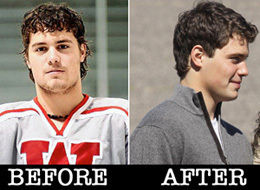 When it was revealed that Sarah Palin's daughter was pregnant, I, like many parent did not jump to condemn mother or daughter but thought "there but for the grace of God . . . ." I don't have daughters but it's the same thing when you hear of a son who has been caught drinking underage or smoking dope or far worse things. Until you have teenage children, I am not sure you can understand how little control you actually have.
On the other hand, I do not know a sensible parent who does have some feel for the values of the people their kids hang out with. It's impossible to police and you can call it helicoptering but it falls well short of real helicoptering -- like the mother who calls to complain about her son's grade.
So what to make of Levi that gun-toting, "I don't want kids (who thinks they do at 18), "Ya f - - - with me I'll kick [your] ass," I'm a f - - -in' redneck," maybe future son in law of the maybe future President? It is possible for a daughter to be close enough to someone so angry to be having sex and not have attentive parents notice? Or maybe Levi and the possible future first dude just hang together.
For me at least, executive experience starts at home and, if you try, some but not all things can be averted. Having your daughter hang with someone who definitely appears to be a bully and cannot find a condom suggests screwed up priorities or bad management.
Thursday, September 04, 2008
What To Do About Sarah Palin
 A colleague who is a regular reader came by my office today. "Jeff," he said, "I cannot believe some of the things people are saying about Sarah Palin. You and I both know that if she only had a degree from Harvard or Yale, most of that criticism would go away."
When I challenged that comment, the response and one that I found hard to answer was "All Bill Clinton needed to clean up his act in the eyes of elitists was a fancy degree. She is no more a "bubba" than he is. This is all about class."
I think he is right in one respect. And I am also sure that her selection for VP by McCain is the most cynical act I have seen recently by a politician because of what it assumes about the basic American voter. The one respect in which he is right is that the discussion is all about class. In fact, it has reached ridicule level.
I am not even remotely tempted to vote for her despite my Schadenfreudidan tendencies that rage when the analysis of the elitists go no further than where she went to school, her pregnant daughter, her snowmobiling husband, and all the other things that they find appalling. Wouldn't it be wonderful to see them sweat if she had all of that and her Yale degree.
I cannot vote for her because I disagree with almost everything that comes out of her mouth. From their discussions it seems that elitists will not vote for her, not because of her ideals, but because she should know better than to aspire to something outside her reach.
Subscribe to:
Posts (Atom)